Showing posts with label Review. Show all posts

Wednesday, 26 November 2014

Edward Scissorhands Review

Fig.1 Movie Poster

Edward Scissorhands is a wonderful story that at its core is about acceptance of everybody even those who would at first seem to threaten a very monotonous life style. The movie follows an eventful section of the life of a person created by a lonely professor. The person in question is called Edward and as you may have guessed, in place of hands he had scissors. It is later explained that Edward's lack of hands can be associated with the inventor who created him, dying before he finished him. Edward, as a result of this, lives in the inventors old house, that is on top of a hill overlooking a dull suburb, by himself for many years. During this time he becomes accustomed to his bladed hands and becomes quite the artist, shaping and trimming the hedges in the grounds. “At the far end of a suburban enclave, where the houses huddle together like a candy-colored wagon train, there stands a monument to lonely genius.” (Maslin, 1990) We can take two things from this, either it is directly referencing the inventor and his ability to make a convincing sentient man and that for of genius or we are looking at Edward himself being on top of the hill and how he in a sense is a genius with his quirky ideas and his innocence to the 'civilized' world, which of course doesn't make him less evolved but rather more open minded. Edward's perception of the world while seeming alien and scary to some, particularly those within the suburban community could also be considered genius and artistic by others.
Fig 2. The Mansion

Taking on that idea, that Edward is an artistic genius, we could go on to further say that it is this genius that people don't understand that makes him truly special. Edward Scissorhands has strong messages as a film that creative people are often outcasts and perhaps question or don't understand why people live and behave the way they do and Burton pushes that idea and personifies it as Edward. It seems as if though Burton is expressing his own experiences through this film because Edward seems so relatable as a character to anyone who feels like an outcast. “Tim Burton showed what he could do when he developed a project of his own. The result is this sweet 1990 fantasy that for the first time crystallized the latent themes in the director’s work: the notion of the artist as outsider, of skills that make one special but at the same time different.” (Blodrowski, 2000) What Blodrowski is pointing at here is that the idea if someone creative being an outsider is a recurring theme in Burton's work and that is because the outsiders have the most special and interesting stories to follow.
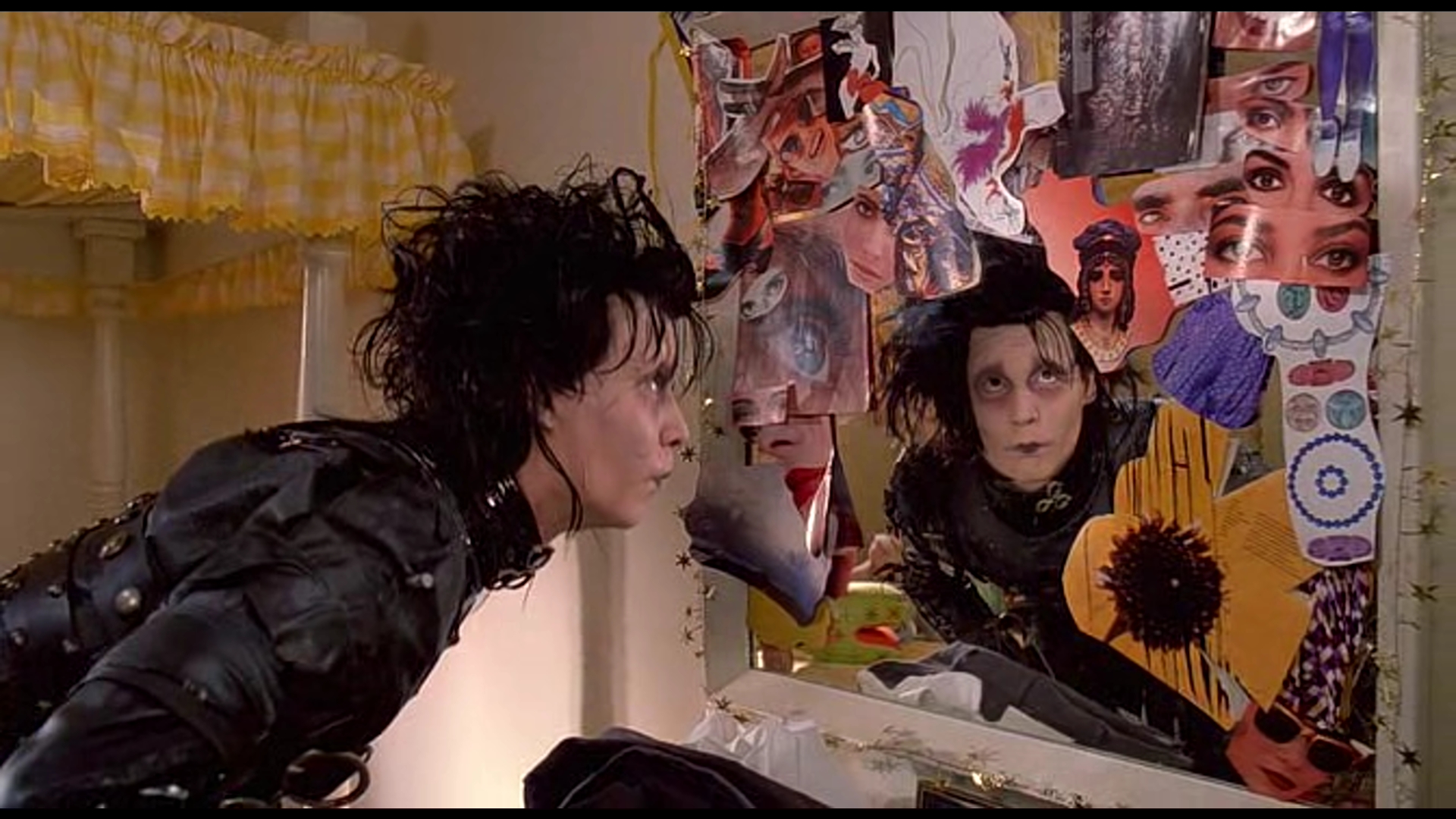
Fig.3 Edward in Kim's Room

After Edward is bought down from the hill he had been residing on and dragged into the suburban community the immediate reaction the audience has is that he doesn't belong there. He is out of place and out of his world. The significance of this is that most of us have felt like that once or twice, new schools, moving across the country and we arrive at a place where we don't really fit in. “The main thrust of the fable is exposing the exotic gentle freak to the boring middle-class suburbs and seeing how they relate to each other, with the monster being the sympathetic innocent and society being the one to fear because of its evil nature.” (Schwarz, 2008) Edward in our eyes is seen as a victim because as viewers we establish a special bond with him and we find ourselves relating to him. The citizens of the town however find him to be at first an exotic fantasy and then an evil monster after his presence leads to a chain of unfortunate happenings. From this we can take the idea that Burton was trying to portray the idea that people are scared of change and excited of change but if something bad happens they will blame it on what they don't fully understand. Taking that onboard this movie is Burton's microcosm representation of society as whole. People get into a repetitive, monotonous scheme of fulfilling their everyday tasks and at first are excited at the prospect of new things and get scared or angry if it ever challenges their life style.
Fig 4. Edward and the Police

All in all I think we can all agree that Edward Scissorhands is a wonderful movie all around, with fantastic acting from Depp and Ryder, glorious set design that helps portray the themes in story and a great musical score that really sets the scene. Tim Burton really did create a classic movie that will be remembered.

Bibliography
Blodrowski. S (2000) Cinefantastique, At:http://cinefantastiqueonline.com/2000/10/edward-scissorhands-tim-burtons-elephant-man/ (Accessed On: 25/11/14)
Schwarz. D (2008) Ozus' World, At:http://homepages.sover.net/~ozus/edwardscissorhands.htm (Accessed On: 25/11/24)

Images
Fig 1. Movie Poster (1990) From: Edward Scissorhands. Directed by: Burton. T [Poster] From America. At: http://upload.wikimedia.org/wikipedia/en/3/3b/Edwardscissorhandsposter.JPG (Accessed on 26/11/14)
Fig 3. Edward in Kim's Room (1990) From: Edward Scissorhands. Directed by: Burton. T [Movie Still] From America. At:http://images5.fanpop.com/image/photos/31900000/edward-edward-scissorhands-31985249-1920-1080.jpg (Accessed on 26/11/14)

Fig 4. Edward and the Police (1990) From: Edward Scissorhands. Directed by: Burton. T [Movie Still] From America. At:http://dejareviewer.files.wordpress.com/2011/12/the-policeman-cares-about-edwards-well-being.jpg (Accessed on 26/11/14)

Tuesday, 7 October 2014

Metropolis Review


Fig 1. Metropolis Poster

Metropolis is undoubtedly one of the most iconic films in history being one of the first films to put to use many interesting camera effects that hadn’t before been seen and using hundreds of models on the large sets to give people the impression of a busy and bustling city. The movie itself took over a year to film due to the need to get authentic looking shots and because of Fritz Lang’s high expectations of the actors.

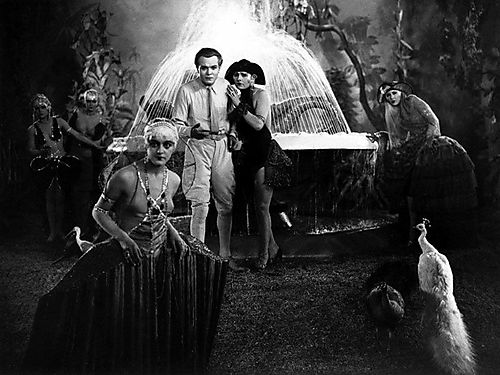
Fig 2. Freder in the Garden

The storyline of this movie is one that has been seen repeated throughout the decades since its release. It is essentially the story of two opposing factions who are bought together through the love of one person of each faction. In this case we have the story told using a Marxist theme and the two factions being the upper class and the workers who are slaves for them. From the upper class however we have Freder who falls in love with a teacher who is a part of the working class called Maria. (C.Smithey) ‘Freder goes searching for Maria only to discover the inhuman working conditions in the city’s giant underground boiler room. He witnesses an explosion that kills many workers and watches as many more are systematically murdered. Freder reports back to his father, who in turn questions Rotwang, the mad inventor responsible for creating the city’s colossal power-driving machine. In a crucial subplot, Rotwang is busy creating a machine-human incarnation of Freder’s mother who, coincidentally looks exactly like Maria.’ The movie progresses and we see the robot Maria sowing seeds of havoc among both the upper class and the workers, convincing the workers that they should destroy the machines and making the upperclass fight each other for her affections. Eventually there is a revolution that is thwarted by the real Maria, Freder and a friend of his called Josaphat.

Fig 3. Tower of Babel

The city that the film is titled for was made using a combination of drawings and models, most of the background art being drawings and everything in the foreground and everything that moves being miniature models that were made for the masterpiece. Actors were transposed onto these sets using a technique called the Schüfftan process which involved using mirrors. (A. Quinn) ‘Its tale of two cities – one for the rich and leisured classes, the other an underground community of anonymous slave labour – is a nightmarish projection of humanity forced to operate as machines, a fate which a hero (Gustav Frolich) and heroine (Brigitte Helm) must strive to avert.’ This of course means that the shining metropolis has a sister city, an underground city below it which is home to the workers that slave away to keep the metropolis running and working. The set design for the underground city was much darker and clustered, making you feel trapped and repressed.

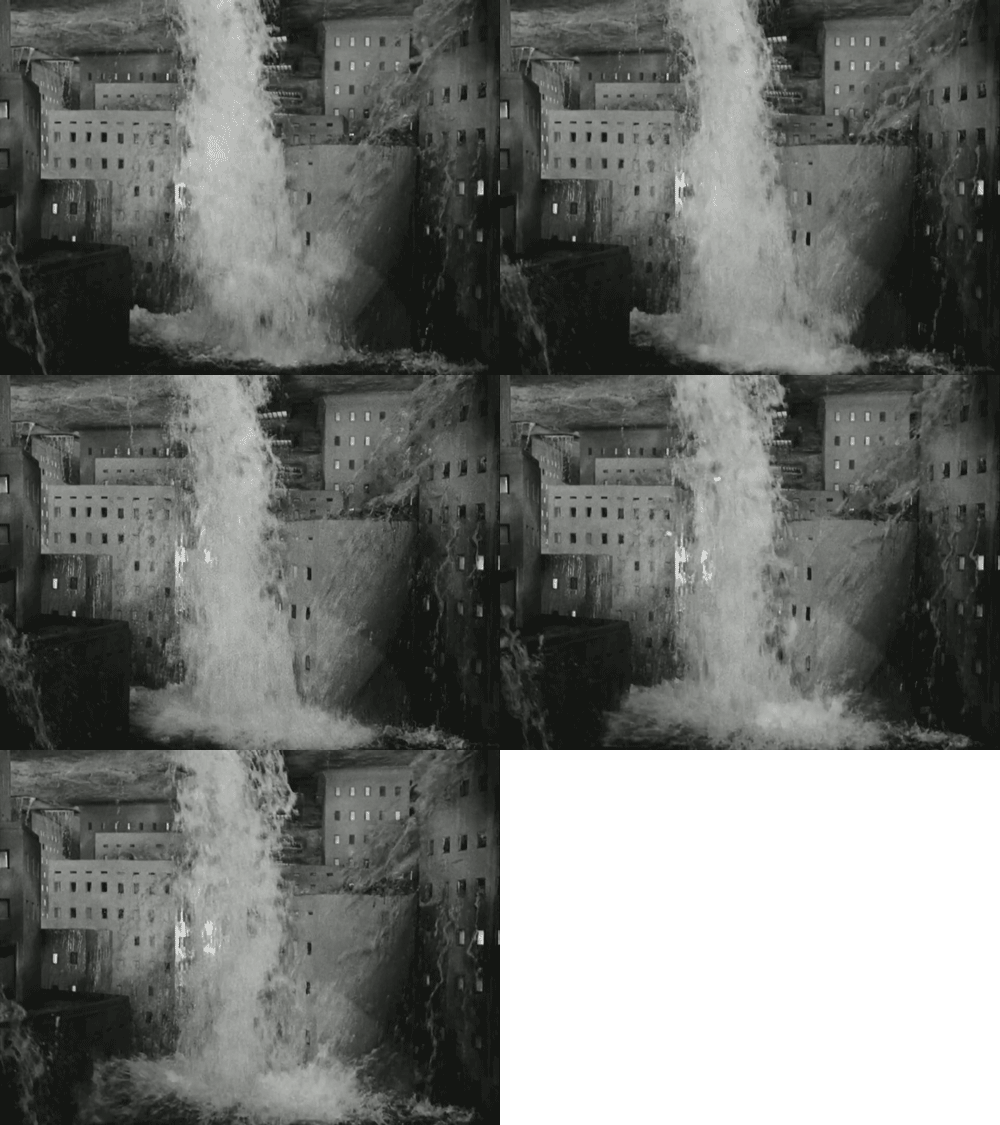
Fig 4. Flooding Worker's City

Metropolis has been a huge influence on modern movies and you can see its themes reflected in many classics particularly those involving futuristic cities, repression and mad scientists. (D. Jardine) ‘Set around the apocalyptic year of 2000, Metropolis has had a seminal influence on science fiction and futuristic movies as diverse as The Bride of Frankenstein, Blade Runner, and Dark City.’ When I watched Metropolis I instantly saw where C-3PO, one of the most iconic Star Wars robots, was spawned from and I saw aspects of every single Indiana Jones movie when the workers district was flooding and there was a sense of urgency will they save everyone in time or won’t they? I also found I could see Corusant, a city planet
from Star Wars, reflected in the over city down to the bustling and business of everything.

All in all the film was enjoyable to watch with action and suspense that we see reflected in cinema to this day. Cleverly made with literally thousands of people acting in it the film was an amazing feat of cinema in 1927 which took over a year to make and despite the lost footage its story and ideas are still an inspiration today.

Bibliography

Images
Lang, F. Fig 1. Metropolis Poster (1927) http://images.posterjunction.com/Metropolis-movie-poster-1020433586.jpg Accessed on 03/10/14
Lang, F. Fig 2. Freder in the Garden (1927) https://janeaustenrunsmylife.files.wordpress.com/2014/10/metropolis07.jpg Accessed on 03/10/14
Lang, F. Fig 3. The Tower of Babel (1927) http://upload.wikimedia.org/wikipedia/en/2/28/Metropolis-new-tower-of-babel.png Accessed on 03/10/14
Lang, F. Fig 4. Flooded Workers City (1927) http://i144.photobucket.com/albums/r180/Samwanda/BLOG%20%20Metropolis/Metropolis120.gif Accessed on 03/10/14


Tuesday, 23 September 2014

3 pages and 2 hours later.... Finished Caligari Review

The Cabinet of Dr Caligari.
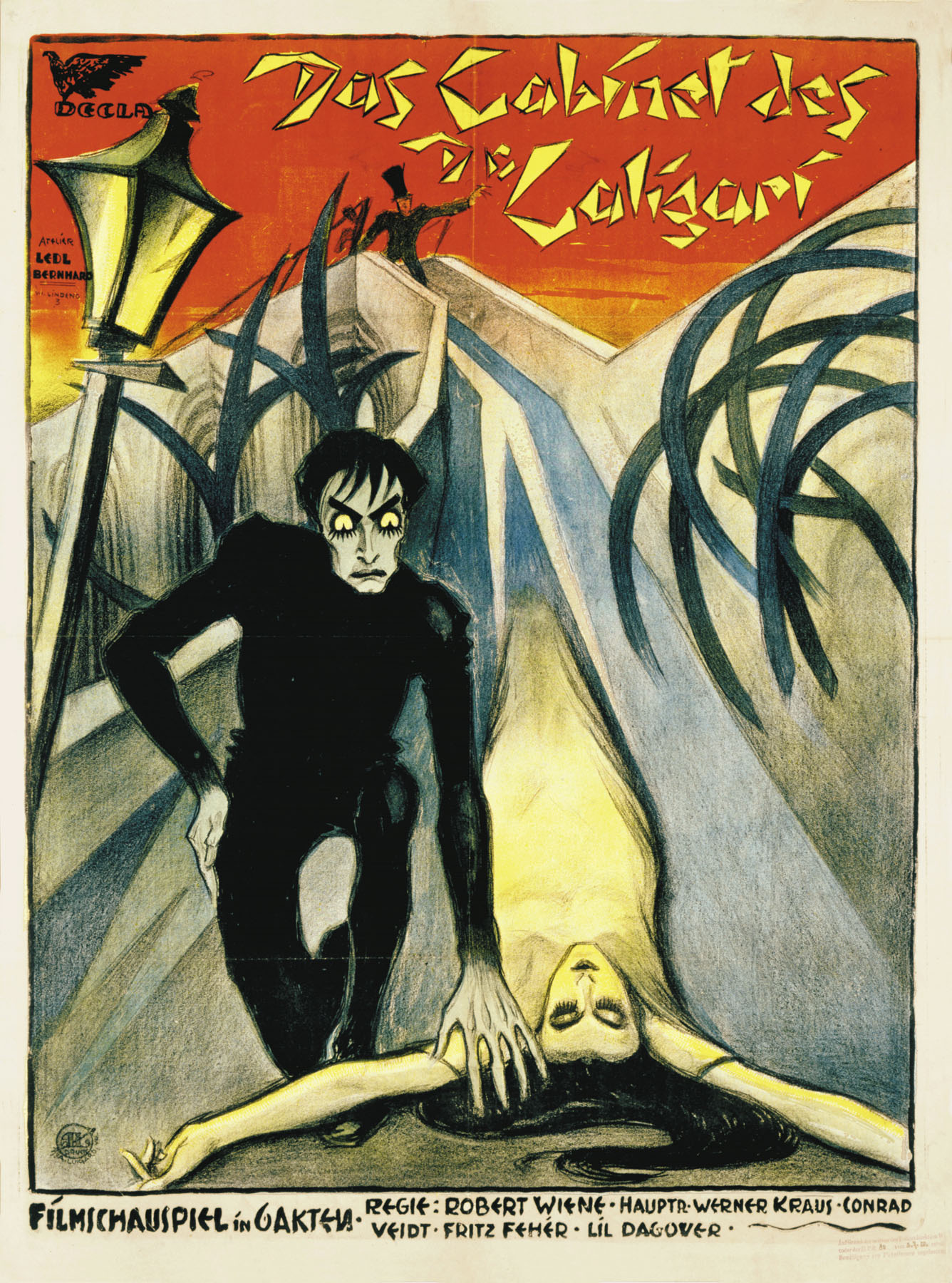
Fig 1. Caligari Poster

The Cabinet of Dr Caligari is an interesting movie to say the least. It is black and white and silent but despite all that it is filled with plot twists, murder, love, deceit and drama, everything a modern classic would have. Of course it won't be everyone's cup of tea but it really is a movie masterpiece if you take a moment to appreciate it and realise a story this complex was captured on film and created into a movie in 1919/1920.

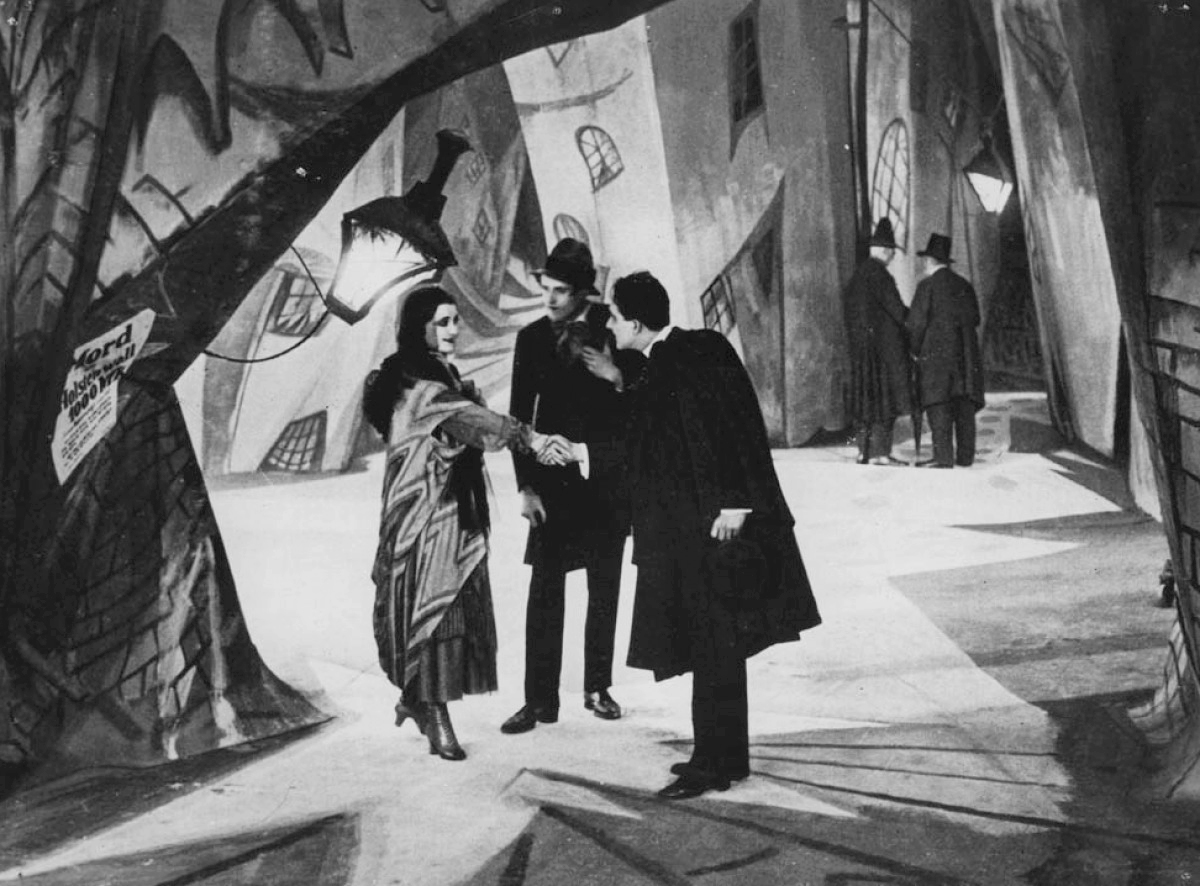
Speaking of story this movie has a difficult one to follow. This can be attributed to the fact that the movie is silent and so there is very little that can give exposition to us but also because the movie is rather cleverly made. It is one of those movies that can change your perspective every time you watch it if a person points out even the littlest detail that you may not have seen before. My synopses of the movie at the moment is that the lead character Mr. Francis who seems like a rather troubled man is telling his story to a stranger (who in my mind is possibly a shrink, having seen the movie beginning to end) and he recounts a fantastical tale of an insane doctor, Dr. Caligari, who has schemes to murder people using a somnambulist called Cesare. A somnambulist is a person who is trapped in a death-like sleep however they can be awakened and ordered to fulfil tasks without question, like a sleeper agent. As Mr. Francis recounts his tale events transpire and Mr. Francis' best friend Mr. Alan is murdered by Cesare and then Cesare attempts to murder the woman Mr. Francis loves, Jane Olsen, but fails as he finds her beautiful so instead resorts to kidnapping her. The kidnapping fails as Cesare runs out of strength and so he places her on the ground and flees into the night. While this is happening Mr. Francis who has started to become paranoid is watching Dr. Caligari and what he believes is Cesare sleep throughout the night. This rules out the fact that Caligari and Cesare are involved in the murders in his mind, however he still has his suspicions and so the next night he returns to Caligari's house with the police and they search Cesare's Box (Cesare sleeps in a box). They discover that the 'Cesare' in the box is actually a doll and Dr. Caligari runs from the police, however he is chased by Mr. Francis. Now this is where the movie gets confusing. Caligari is chased to an asylum and disappears inside. Mr. Francis follows him and asks the people who work there if Dr. Caligari was a patient there. They reply to him that there is no Dr. Caligari in the asylum to their knowledge however the Director had just arrived and he (Mr. Francis) could ask him. Mr. Francis goes to the Director's office and who is sitting behind the desk? None other than Dr. Caligari! Francis quickly leaves the room and tells one of the workers that the Director is Dr. Caligari. See? I told you it gets confusing. A bit more confusion to go though. That evening Francis returns to the asylum with the police and they look through the Director's research notes and discover that Caligari was infact an 11th century mystic who would wander from town to town with his somnambulist and murder townsfolk. We the audience experience some flashbacks and discover that is what the Director was trying to replicate, or was it? See this is where I believe everyone has their own thoughts on what happened and these are mine. You see during one of these 'flashbacks' we see the Director get admitted to his own asylum and then they finish. The next shot we see is subtly different and I will explain why in a moment but in it we see Francis walk out of the asylum and into the courtyard with the stranger from the beginning. They walk past Cesare, who if he did murder those people should be in prison should he not? Also Cesare is awake and holding flowers which is also strange but pieces of the puzzle start to come together in your head. We also see Francis walk up to Jane who is sitting in the courtyard and asks her to marry him. She doesn't even look at him and says no because she is the queen and cannot marry outside royal blood. We are told throughout the film that she is in love with Francis so this is also very strange. Then comes the most significant part of the scene. The Director walks out of the asylum and down into the courtyard. Didn't we just see him get put into the institute?! As he walks into the courtyard he is attacked by Mr. Francis who is subdued and taken into the asylum. We finish with the Director saying “At last I recognise his mania, he believes me to be the mythical Caligari. Astonishing! But I think I know how to cure him now.” I believe that Francis lost his friend Mr. Alan and it sent him mad, he was admitted to the asylum and he blamed the death on a story character, Dr. Caligari, making various people in the institute into characters from the novel, imagining it all. This can most prominently be seen in the movie sets and backdrops, remember how I mentioned there was a subtle difference earlier? This is in the courtyard back drop. Everything in this backdrop is very square and shaped smoothly and evenly whereas before all the back drops were twisted and sinister with clawing shadows and huge contrast between light and dark. “The exaggerated, largely cold and sinister look of all subjects and objects is the first hint that we just might be inside someone’s nightmare.” (Kaufman)

Fig 2. Courtyard Fig 3. Town Square

Fig. 4 Cesare

“Robert Wiene's silent classic has always been considered a keystone of the horror genre.” (Parkinson). It is easy to see why people would consider this film to be the forefather of modern motion pictures especially impressionist films and horror films. In so many films made since this one you can see reoccurring themes, scenes and styles. When I watched I was reminded instantly of 3 movies, The Imaginarium of Dr Parnassus, Bram Stokers Dracula and Edward Scissorhands, all for different reasons. The Imaginarium of Dr Parnassus takes on a similar idea that there is this surreal, story telling world however as the movies draw to a close we discover there is a darker reason for the world existing, in Caligari it is because it is imaginary, in a mental patient's head and in Parnassus it is because there is an on going fight with the Devil. I was reminded of Dracula plainly and simply through the scene where Cesare breaks into Jane's room, it reminded me of how the supposedly evil, monstrous character can find something beautiful still and I think the exaggerated shadows also reminded me of Dracula when he is in his castle and of course the fact that Cesare sleeps in a coffin shaped box is very vampiric. Lastly I was reminded of Edward Scissorhands because of the establishing shot which showed the sprawling town of Hostenwall rising into the sky on the side of a hill. The spindly sharp style of the town reminded me of the house at the top of the hill in Edward Scissorhands and as the film progressed it was easy to see where Tim Burton got his style and inspiration from, it is particularly obvious in his animations like Nightmare Before Christmas and The Corpse Bride. Another theme that Burton and of course many other directors have taken from this film is the gothic idea behind it, pale faces and dark clothes, contrasting to give a haunting appearance. No one can deny it is possibly the most influential pieces of cinema ever created. “Undoubtedly one of the most exciting and inspired horror movies ever made.” (DP)

In conclusion I believe that The Cabinet of Dr. Caligari may be one of the greatest movies ever created, certainly not in my top 5 favourite but I appreciate that without this film so many other films I have come to know and love over the years wouldn't exist. It was in its time a visionary masterpiece which would have made audiences feel intrigued and uncomfortable at the same time by utilizing the very impressionist style backgrounds which gave the gothic horror and even more nightmarish feel. Also I think that some of the shots and ideas where amazingly done considering that the film was made in 1920 and I do believe it is a work of genius for its time.


Bibliography


Pictures
Wiene, R. Fig 1. Caligari Poster (1920) - http://cdn8.openculture.com/wp-content/uploads/2013/10/Cabinet-Of-Dr.-Caligari-.jpg (accessed on 23/09/14)


Wiene, R. Fig 3. Town Square Still (1920) - http://upload.wikimedia.org/wikipedia/en/f/fd/CABINET_DES_DR_CALIGARI_01.jpg (accessed on 23/09/14)